What Is an AI Data Center? Features and Benefits
What Is an AI Data Center is a common question as artificial intelligence becomes part of business, healthcare, finance, science, education, and online services. An AI data center is a special facility built to run powerful AI systems. It combines GPUs, AI accelerators, servers, high-speed networks, large storage systems, strong power supplies, and advanced cooling.
What Is an AI Data Center?
An AI data center is designed mainly for artificial intelligence and machine learning workloads. A normal data center may run websites, databases, email systems, and business software. An AI-focused facility can also support these services, but it is made for much heavier computing jobs. Large AI models may use hundreds or thousands of processors at the same time.
Companies use these centers for AI training, inference, data processing, model testing, and cloud AI services. Their systems are built to move very large amounts of data quickly while keeping powerful processors active and stable.
How Does an AI Data Center Work?
To understand What Is an AI Data Center, it helps to follow the path of data. First, large amounts of information are collected and stored. This can include text, images, videos, audio, code, or business records. The data is cleaned and prepared before it is sent to AI processors. These processors then perform huge numbers of calculations to find useful patterns.
After training, the model moves into inference. Inference happens when a user asks a chatbot a question, creates an image, translates text, or uses another AI service. The data center processes the request and sends the result back.
Key Features of an AI Data Center
An AI data center needs several systems working as one platform. The most important feature is high-performance computing. Modern AI workloads often use GPUs because they can perform many calculations at the same time. Special AI accelerators may also be used for machine learning, deep learning, and fast inference.
Other important features include fast storage, low-latency networking, security, backup power, monitoring, and advanced cooling. A company may start with a few GPUs and later add more racks, storage, and network capacity as its AI projects grow.
GPUs, AI Accelerators, and High-Performance Computing
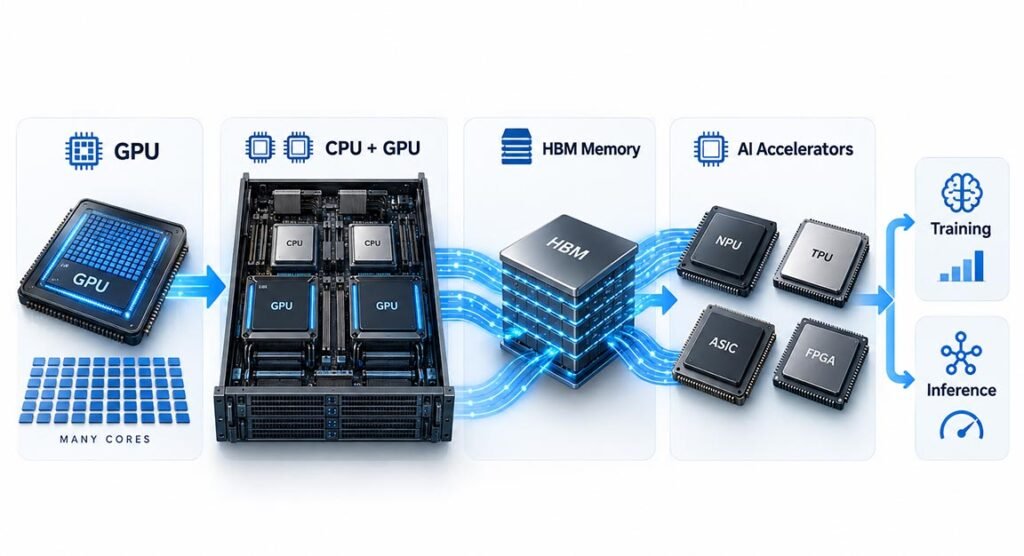
GPUs are at the center of many AI systems. They were first created mainly for graphics, but their parallel design is very useful for artificial intelligence. A GPU can handle many mathematical operations at once.
Modern systems may combine CPUs and GPUs in the same rack. Some advanced platforms contain dozens of GPUs connected through very fast links. High-bandwidth memory, also called HBM, helps by moving large amounts of information to processors quickly.
AI accelerators can also be designed for special tasks. Some chips focus mainly on model training, while others are optimized for fast inference and lower power use.
Power, Cooling, and Energy Requirements
Power demand is a major issue for modern AI infrastructure. AI hardware can use a large amount of electricity. A high-density rack may need far more power than a traditional server rack. The facility must therefore have strong electrical systems, including transformers, power distribution equipment, backup batteries, and generators.
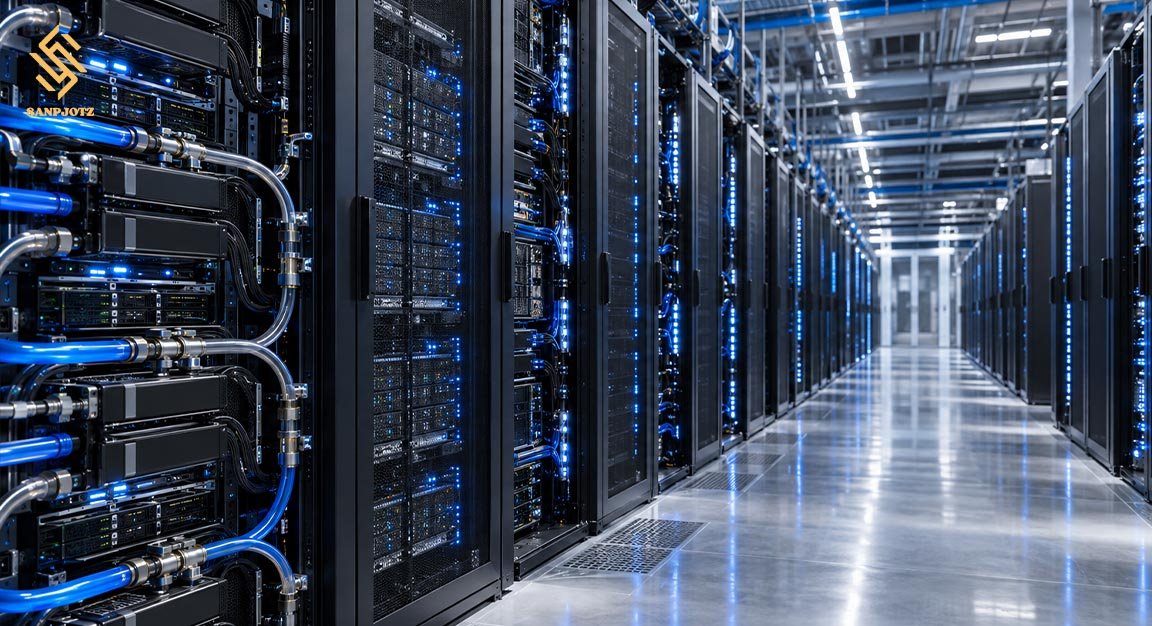
Cooling is equally important because powerful processors create a lot of heat. Traditional facilities often use air cooling, but very dense AI racks may need direct-to-chip liquid cooling. Liquid can remove heat more efficiently than air and can help keep powerful processors at safe temperatures.
AI Data Center Networking and Storage
Fast networking allows many AI processors to communicate without long delays. Technologies such as high-performance Ethernet, InfiniBand, NVLink, optical links, and advanced switches can connect servers, racks, and GPUs.
Storage is also critical. AI projects can use very large datasets, so the facility needs storage with high capacity and high speed. It may use NVMe drives, flash storage, object storage, and distributed file systems.
The network and storage systems must work closely with the computing hardware. If data cannot reach the GPUs quickly enough, expensive processors may sit idle and overall performance can fall.
AI Data Center vs Traditional Data Center
A simple comparison makes What Is an AI Data Center easier to understand. A traditional facility is normally designed for general computing. It may mainly use CPUs and support websites, databases, business applications, and cloud services.
An AI-focused center is built around large numbers of GPUs or other accelerators. It needs faster processor communication, more memory bandwidth, stronger cooling, and often more electricity per rack.
Traditional servers can often complete tasks separately. AI training is different because hundreds or thousands of processors may need to work together on the same model.
Main Benefits of AI Data Centers
One major benefit is faster AI training. A powerful GPU cluster can process large datasets much faster than a small group of ordinary servers. Strong infrastructure can also support many users at once during inference.
Another benefit is scalability. Companies can add more compute, storage, and network capacity as demand grows. Cloud AI centers also give smaller companies access to advanced hardware without requiring them to build a complete facility.
AI centers can also improve resource sharing. Different teams can use the same computing platform for training, testing, research, and AI applications.
Common Challenges and Limitations
AI infrastructure is powerful, but it is expensive. Advanced GPUs, networking equipment, storage, cooling systems, land, construction, and electricity can require a large investment.
Other challenges include heat, water use, hardware supply, skilled workers, cybersecurity, reliability, and environmental impact. Operators also need to improve energy efficiency so more computing work can be completed with less waste.
Another challenge is rapid technology change. New generations of AI chips may require different power, cooling, and networking systems. Data centers must therefore be designed so they can support future upgrades.
Where AI Data Centers Are Used
AI data centers support chatbots, generative AI, search engines, recommendation systems, fraud detection, translation, image generation, video generation, medical research, robotics, weather modeling, cybersecurity, and software development tools. The exact design depends on whether the main job is training models, serving users, or doing both.
What Is an AI Data Center finally comes down to one idea: it is a specialized facility built to give artificial intelligence the speed, power, storage, networking, and cooling it needs. Its biggest benefits are high performance, scalability, faster model training, and reliable AI services. As AI use grows, these facilities will become an important part of digital infrastructure.
FAQs
What is the main purpose of an AI data center?
Its main purpose is to provide the computing power, storage, networking, and cooling needed to train AI models and run AI services.
Why do AI data centers use GPUs?
GPUs can perform many calculations at the same time, making them efficient for machine learning and deep learning tasks.
Do AI data centers use more electricity?
Yes, they can use much more electricity because high-performance GPUs and dense server racks require large amounts of power and cooling.
What cooling system is used in AI data centers?
They may use air cooling, liquid cooling, or both. High-density AI racks increasingly use direct-to-chip liquid cooling.
Are AI data centers the same as cloud data centers?
Not always. A cloud data center can support many workloads, while an AI data center is specially designed or optimized for AI training and inference.