
Harvey AI Review: Features and Use Cases
Harvey AI is a legal technology platform built for law firms, in-house legal teams, and other professional service groups. It helps users research legal questions, review contracts, summarize documents, draft text, and manage large document sets. The platform combines generative artificial intelligence with legal research tools, secure workspaces, and workflow automation. Its main aim is to reduce repetitive work while lawyers focus on judgment, strategy, negotiation, and client needs.
What Is Harvey and How Does It Work?
Harvey works like an advanced professional assistant. A user can type a question, upload documents, or give a task in normal language. The system studies the available material and creates an answer, draft, summary, or structured analysis.
The platform is made for professional legal work rather than general everyday chat. It can support research, contract analysis, due diligence, litigation preparation, and internal legal operations.
Key Features of Harvey AI
One of the main tools is Assistant. It lets lawyers ask questions, work with documents, create drafts, and perform deeper analysis. Other major tools include Vault for large document collections, Review Tables for structured data extraction, and Workflow Agents for repeated tasks. These tools are designed to work together instead of acting like separate products.
Harvey also supports different advanced AI models for complex legal work. Its product tools can help teams move between research, document review, drafting, and automated workflows without using many separate systems.
Legal Research and Case Analysis
Legal research can take many hours because lawyers must find laws, cases, regulations, and supporting material. Harvey AI can help users search legal sources, compare authorities, summarize long decisions, and study a legal question from different angles.
However, users must still check citations, dates, facts, and legal meaning before relying on the result. AI can misunderstand context or miss important details. For serious legal work, the safest approach is to use the system for support while a qualified professional reviews the final answer.
Contract Review and Drafting
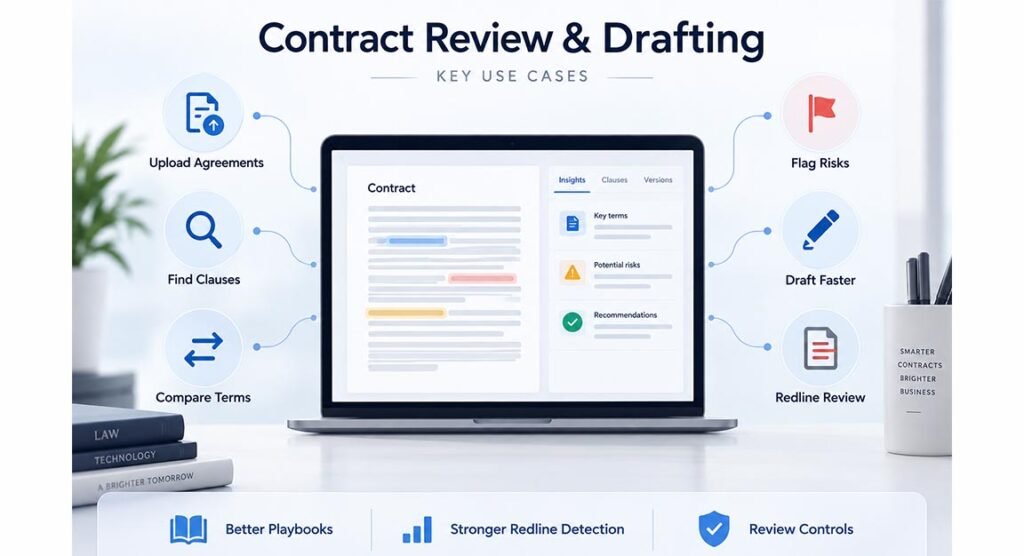
Contract work is one of the strongest use cases. A legal team can upload agreements and ask the system to find clauses, compare terms, identify missing language, or flag positions that do not match a company playbook.
Drafting is another useful area. Users can prepare a first draft, improve wording, summarize changes, or create an issue list from a redline. In 2026, Harvey expanded its contract tools with improved playbooks, stronger redline detection, and more detailed review controls.
Vault, Review Tables and Workflow Agents
Vault is designed for document-heavy matters. It lets teams upload, store, search, and analyze large groups of files in one workspace. A lawyer may use it for due diligence, discovery, contract portfolios, investigations, or litigation.
Review Tables turn information from many documents into a structured grid. For example, a team can create columns for governing law, renewal date, termination rights, or change-of-control clauses. Harvey has improved these tables with better citations, faster review, bulk actions, cell locking, and guided table creation. Workflow Agents can automate repeated steps across similar matters.
Main Legal Use Cases
Harvey AI can support many legal tasks. In M&A, teams can review contracts during due diligence and identify important risks. In litigation, they can organize documents, study evidence, prepare summaries, and research legal questions. In-house teams can review supplier agreements, answer internal legal questions, check company policies, and compare contract terms.
The platform may also help with regulatory and compliance work. Teams can study rules, review policies, and search large sets of business documents. These uses may save time, but important output still needs professional review, especially when a mistake could affect a client, court filing, transaction, or legal duty.
Integrations, Security and Data Privacy
Legal documents often contain confidential information, so security is a major concern. Harvey provides enterprise controls for professional organizations that need stronger access management than a normal consumer chatbot. Teams should still review their own professional duties, privacy rules, and internal AI policies before uploading sensitive information.
The platform can also work with existing document and productivity systems. This matters because many lawyers already store files in cloud services and document management tools.
Pricing and Availability
Harvey AI is mainly aimed at organizations rather than casual individual users. It does not follow the simple public pricing model used by many consumer AI tools. Business customers normally discuss their needs with the company, and pricing may depend on team size, deployment, selected products, and the level of access required.
For a law firm, the real cost may also include training, security review, integrations, governance, and internal support. The main question is whether the time saved on research, review, drafting, and document analysis gives enough value to justify the full cost.
Benefits and Limitations
The biggest benefit is efficiency. The platform can help professionals read, organize, compare, and summarize information much faster. It can also improve consistency by using repeatable workflows and structured review methods. Review Tables are especially useful when a team must compare the same information across hundreds or thousands of files.
The main limitation is that AI is not legal judgment. It may miss facts, misunderstand unclear wording, or give an answer that sounds more certain than the evidence supports. Lawyers must verify important output and understand the wider business or legal context before acting on it.
Is Harvey Worth Using in 2026?
For large law firms and legal departments, the platform can be valuable when teams handle high volumes of research, contracts, or documents. Its main strength is the combination of Assistant, Vault, Review Tables, legal research, and Workflow Agents in one environment. New 2026 updates have also made document review and complex analysis more flexible.
For users who only need occasional general answers, the platform may be more than they need. Its value is strongest for professional teams with repeatable, document-heavy work and clear rules for human review. Used carefully, it can reduce repetitive tasks and give lawyers more time for analysis, strategy, negotiation, and client communication.
FAQs
What is Harvey used for?
It is mainly used for legal research, contract review, drafting, due diligence, document analysis, litigation support, and repeatable professional workflows.
Can Harvey replace a lawyer?
No. It can speed up research and document work, but lawyers still need to check legal meaning, citations, facts, risks, and final decisions.
What is Harvey Vault?
Vault is a workspace for storing and analyzing large groups of documents. It is useful for due diligence, contract portfolios, litigation, and investigations.
Does Harvey support contract review?
Yes. It can identify clauses, compare documents, review terms against playbooks, study redlines, and organize findings into structured tables.
Who should use Harvey?
It is most useful for law firms, in-house legal departments, and professional teams that handle large amounts of research, drafting, and document review.