

Open Source AI Models: Features and Uses
Open Source AI Models are changing how people build and use artificial intelligence. Instead of depending only on closed services, developers can download many models, run them on their own systems, study how they work, and change them for special tasks. This gives more freedom, but it also creates important questions about licences, hardware, privacy, safety, and what “open source” really means.
What Does Open-Source AI Mean?
Open Source AI Models are AI systems that give users broad rights to use, study, modify, and share them. The Open Source Initiative (OSI) says true open-source AI should also provide the important parts needed to understand and change the system, including model parameters, code, and detailed information about training data.
A model is more than a file of trained weights. It also includes its architecture, software, training process, documentation, and licence. This is why users should check what is actually available before calling a model fully open.
Open-Source vs Open-Weight AI
The terms open source and open weight are often mixed together. An open-weight model gives users access to trained parameters. This can allow local use and fine-tuning, but the full training code or detailed data information may still be missing.
The OSI Definition 1.0 uses a stricter standard. It says people should be free to use, study, modify, and share an AI system, with access to the material needed to make meaningful changes.
Main Features That Make These Models Useful
One strong feature is local deployment. A model can run on a laptop, workstation, private server, or company cloud. This can reduce the need to send every request to an outside provider. For businesses handling private documents, source code, or internal research, that extra control can be valuable.
Another feature is customisation. Developers can fine-tune models, connect private data, add tools, change prompts, and build special interfaces. Open Source AI Models can support chat, coding, translation, document search, image understanding, customer service, and other practical jobs.
Popular Model Families to Know
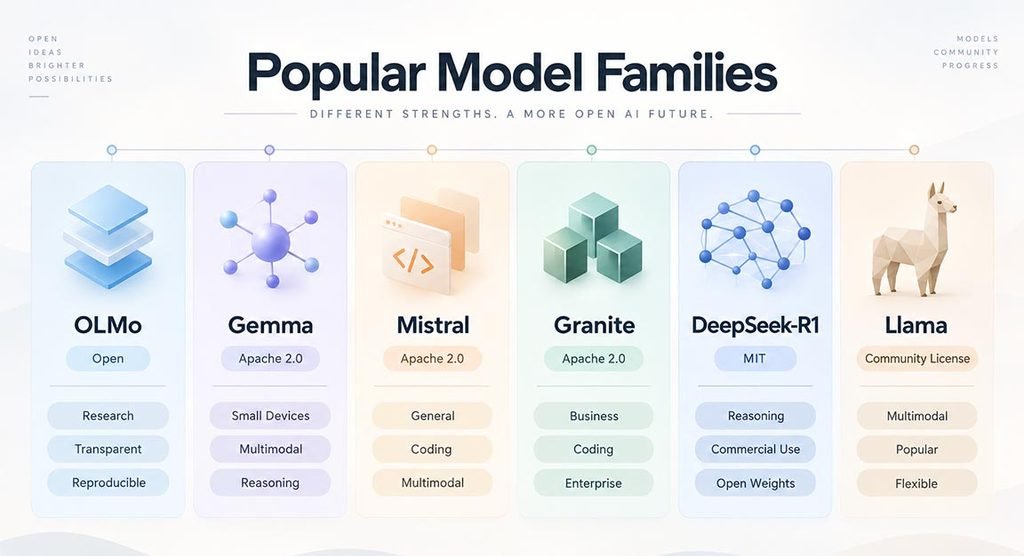
Well-known families include OLMo, Gemma, Mistral, Granite, DeepSeek, and Llama, but they do not all use the same licence or level of openness. Some focus on research transparency, some on small-device use, while others are made for coding, reasoning, multimodal work, or business systems.
Mistral lists several models under Apache 2.0, including general, coding, reasoning, and multimodal models. DeepSeek-R1 uses the MIT licence for its main code and weights and allows commercial use and modification. Users should still check the licence of each exact model or distilled version.
How Open Models Work
Most modern language models learn from very large sets of text, code, images, audio, or other data. During training, the system finds patterns and stores learned information in numbers called parameters or weights. A model can have billions of parameters, but a larger size does not always mean better results.
After basic training, developers may use extra training to improve instruction following, reasoning, coding, or safety. Some models also use Mixture of Experts (MoE), where only part of the model is active for a task. This can help large models use computing power more efficiently.
Common Uses in Real Projects
Open Source AI Models are used for private chatbots, coding assistants, document search, translation, education, research, customer support, data extraction, and report summaries. A business can also connect a model to internal files so staff can ask questions without using a public chatbot for every task.
A popular method is Retrieval-Augmented Generation (RAG). RAG finds useful information from trusted documents and gives it to the model before it answers. This is useful for company knowledge, product guides, research files, and other information that changes often.
Fine-Tuning, Quantisation, and Local Use
Fine-tuning means training an existing model on a smaller set of special examples. It can teach a model a certain writing style, answer format, or work process. Fine-tuning is good for changing behaviour, while RAG is often better when the main goal is to use current facts from documents.
Quantisation reduces the memory needed to run a model by storing its weights in smaller numerical formats. It can make some models practical on consumer hardware. However, large models may still need strong GPUs, more memory, or several servers.
Benefits for Developers and Businesses
The main benefits are control, flexibility, privacy, and choice. Developers can decide where a model runs, how it connects to other systems, and what data it uses. Local systems can also work offline and reduce dependence on one API provider.
Cost can be another benefit, but a downloadable model is not a free AI system. Self-hosting still needs hardware, electricity, storage, security, updates, and technical support. For small workloads, an API may be easier. For larger workloads, self-hosting may give better control over cost.
Risks, Licensing, and Hardware Requirements
These models can still produce false facts, weak reasoning, biased answers, or unsafe results. Open access does not remove the need for testing, human review, security controls, and privacy rules. Systems that can use tools or private files need even stronger protection against harmful commands and data leaks.
Licensing also needs careful attention. Open Source AI Models do not all follow the same rules. Before business use, check whether the licence allows modification, redistribution, commercial products, and hosted services. Hardware should also be tested for model size, context length, speed, and the expected number of users.
How to Choose the Right Model
Start with your real task. Decide whether you need text, images, coding, long documents, multiple languages, reasoning, or tool calling. Then compare licence terms, model size, hardware needs, context window, fine-tuning support, security, documentation, and community support.
The biggest model is not always the best choice. A smaller model that gives reliable answers at good speed can be more useful. Test several models with your own examples before making a final decision.
FAQs
What is an open-source AI model?
It is an AI system that gives users rights to use, study, change, and share it. A strict definition also expects access to key code, parameters, and training information.
Can I run an open model on a laptop?
Yes. Small or quantised models may run on modern laptops. Large models can need a powerful GPU or dedicated server.
Are these models free for commercial use?
Not always. Some licences allow wide commercial use, while others have extra conditions. Always read the exact licence first.
What is the difference between RAG and fine-tuning?
RAG gives the model information from documents. Fine-tuning changes its behaviour by training it on selected examples.
Are open models safe?
They can be useful, but they still need testing, privacy controls, security, and human review. Open access does not guarantee safe or correct answers.