Industrial Automation Software for Modern Industries
Industrial Automation Software helps factories control machines, collect production data, reduce manual work, and improve daily operations. It connects sensors, motors, robots, controllers, operator screens, production systems, and business tools. It helps plants make work safer and more consistent while giving teams a clearer view of production, quality, maintenance, and machine performance.
How Modern Industrial Automation Works
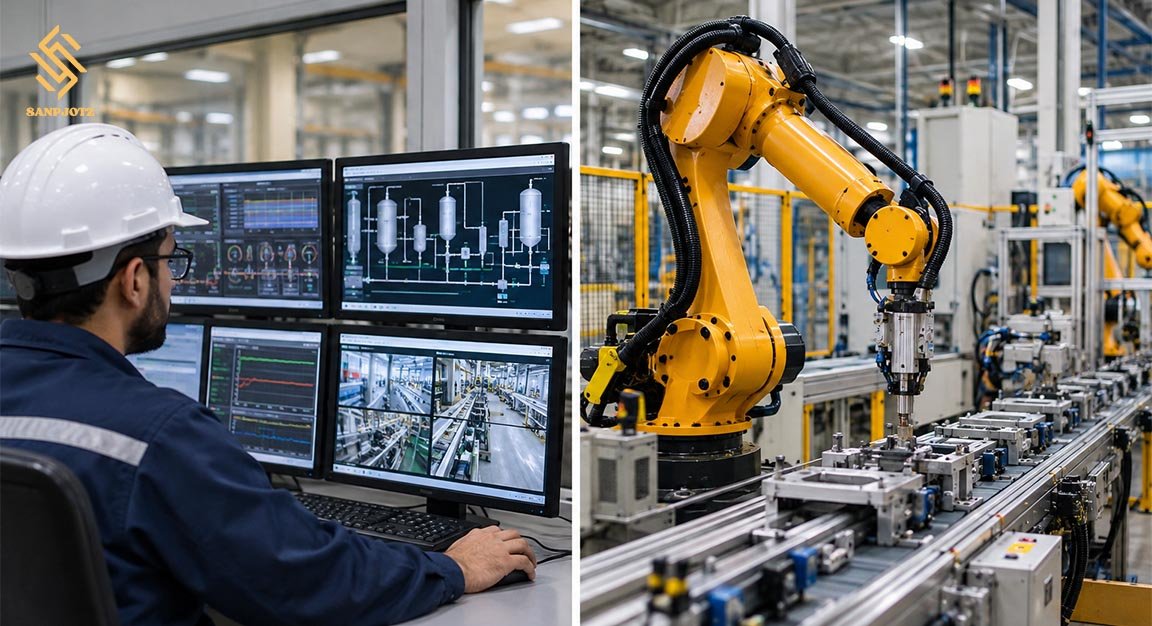
Automation software receives information from sensors, checks it, and starts the right action. A temperature sensor may send a value to a PLC, which follows programmed rules and changes a valve, motor, speed, or alarm. Operators watch the process through an HMI or SCADA screen and respond when values move outside the normal range.
ISA-95, also called IEC 62264, organizes industrial and business functions into layers. Level 2 includes control systems, Level 3 covers manufacturing operations, and Level 4 includes business planning such as ERP. This model helps companies understand how information should move between plant equipment and business systems.
Main Types of Industrial Automation Software
Common types include PLC programming tools, HMI software, SCADA platforms, DCS software, MES systems, historians, robotics software, and edge platforms. PLC tools create control logic. HMI software gives operators visual controls. SCADA supervises larger systems, while a DCS is often used in continuous processes such as chemical, energy, oil, and water plants.
MES software manages orders, materials, quality, downtime, and work progress. Historians store time-based plant data for later analysis. Edge software processes information near machines, which can reduce delay and limit how much data must travel to cloud systems. These tools often work together.
Features That Matter in a Modern Plant
A useful platform should offer real-time monitoring, alarms, data logging, reports, user access control, device connectivity, backups, and clear dashboards. Engineers also need configuration, testing, version control, and fault-finding tools. Good software should show what changed and who made the change.
Industrial Automation Software should also support open communication when possible. OPC UA is a platform-independent standard for secure information exchange between sensors, control systems, MES, ERP, IIoT systems, and cloud applications. It also supports information models, which help systems understand what data means instead of sharing only raw numbers.
How Automation Improves Production
Automation helps machines follow the same programmed steps again and again. This can support stable quality, repeatable cycle times, and faster output. Software can collect measurements automatically, so workers do not need to depend only on paper checks. When a problem appears, alarms and stored history can help engineers find the cause faster.
Automation also gives people better information and removes repetitive tasks. Operators can focus on safety and process problems. Maintenance teams can study machine condition, while managers compare targets with real production results. This can reduce waste and unplanned downtime.
How PLC, HMI, SCADA, and MES Connect
A PLC controls equipment in real time. An HMI shows machine status to an operator. SCADA collects and displays information from many controllers or remote sites. MES works at a higher level and connects production activity with schedules, quality records, materials, and work orders.
Industrial Automation Software becomes more useful when these layers exchange trusted data. An MES can send a production order, a PLC can control the process, and SCADA can record operating values. The completed quantity can then return to the business system. This reduces repeated data entry and gives teams a shared view of operations.
Machines, IIoT, Edge, and Cloud Connections
Many factories use machines from different years and suppliers. One machine may use modern industrial Ethernet, while another depends on an older field network. Gateways, protocol converters, OPC servers, and edge devices can help these systems share data without forcing a company to replace every older machine.
The Industrial Internet of Things (IIoT) adds connected sensors and smart devices. Their data can support dashboards, energy analysis, remote support, quality checks, or condition monitoring. Cloud platforms can store information, while edge systems handle fast local processing.
Business Benefits for Modern Industries
Industrial Automation Software can improve production visibility, reduce human error, support product consistency, and give teams faster access to operating information. In industries with strong quality rules, digital records can also make it easier to trace batches, process values, alarms, machine states, and operator actions.
It can also support predictive and condition-based maintenance. Teams can watch vibration, temperature, pressure, current, or other machine signals. Software may identify unusual patterns before failure happens. This can help maintenance teams inspect equipment earlier and plan work with better information.
Integration and Cybersecurity Challenges
Integration is often difficult because plants may have old controllers, closed vendor systems, different data names, and machines that do not easily communicate. Companies must also connect operational technology (OT) with IT systems without reducing production reliability. Standards help, but teams still need testing, data mapping, backups, and change control.
Cybersecurity is just as important because industrial systems control physical equipment. NIST explains that cyber incidents in industrial control systems can affect operations and worker safety. Useful controls include authentication, authorization, application allowlisting, file-integrity checking, anomaly detection, and controlled system changes.
How to Choose the Right Platform
Start with the production problem instead of choosing software only because it has many features. Define which machines must connect, how quickly data must move, how many people need access, and what reports are required. Also check compatibility with existing PLCs, drives, robots, databases, networks, and ERP systems.
Before buying Industrial Automation Software, review scalability, vendor support, licensing, cybersecurity, training, open standards, backup options, and total cost of ownership. A small pilot project can show how the system works with real plant equipment before a larger rollout. Staff training and long-term maintenance should also be planned.
AI, Digital Twins, and Smart Factory Trends
Modern automation is adding AI, machine learning, digital twins, edge computing, and cloud services. AI can help find unusual patterns, support visual inspection, or improve maintenance decisions. Digital twins create software-based models of machines or processes, allowing engineers to compare expected and real behavior and test ideas before changing physical equipment.
New technology does not remove the need for strong basic engineering. Reliable sensors, safe PLC logic, stable networks, correct data, cybersecurity, and trained people are still essential. Strong smart factories connect machine control, operations, maintenance, business information, and analytics in one clear system.
FAQs
What does automation software do in a factory?
It controls or monitors industrial equipment, collects operating data, creates alarms, supports workers, and helps production teams manage processes.
What is the difference between PLC and SCADA software?
PLC software programs real-time machine control. SCADA software supervises larger processes and gathers information from controllers, sensors, and remote equipment.
Can old machines connect to modern automation systems?
Yes. Many older machines can connect through gateways, protocol converters, data acquisition hardware, or edge devices, although compatibility should be tested first.
Is cloud software required for factory automation?
No. Core machine control can run locally. Cloud services are optional and are often used for analytics, storage, remote access, or multi-site reporting.
Why is cybersecurity important in industrial systems?
These systems control real equipment. A security problem can stop production, change process values, damage equipment, or create safety risks, so access and network protection are essential.