

Generative AI Models: Features and Examples
Generative AI Models are computer systems that learn patterns from large amounts of data and then create new content. They can produce text, images, code, audio, music, and video from simple instructions. Unlike older AI systems that mainly classify or predict information, generative systems can build something new. Today, businesses, developers, students, designers, and writers use this technology for many daily tasks, from answering questions to creating digital media.
What Are Generative AI Models?
Generative AI Models are machine learning systems designed to generate new information based on patterns learned during training. They study large datasets and understand connections between words, pictures, sounds, or other forms of data. After training, they can respond to a user’s prompt with new content that follows these learned patterns.
For example, a language model can receive the instruction “Write a short email about a meeting” and create the email. An image model can receive “Create a modern house near a lake” and produce a new picture. The result is generated for the request rather than simply copied from a stored file.
How Generative AI Models Work
Most Generative AI Models start with a training process. During training, the system receives a large amount of data. A text model may study books, websites, articles, code, and other written material. The model finds patterns between words and ideas. These patterns are stored through mathematical values called parameters, which help it decide how to create future outputs.
When a user gives a prompt, the system processes the instruction and predicts a suitable result. Language models often generate text one token at a time. A token can be a word, part of a word, or punctuation. Image models may use a different process. Diffusion models, for example, can begin with random noise and slowly turn it into an image that matches the prompt.
Main Features of Generative AI Models
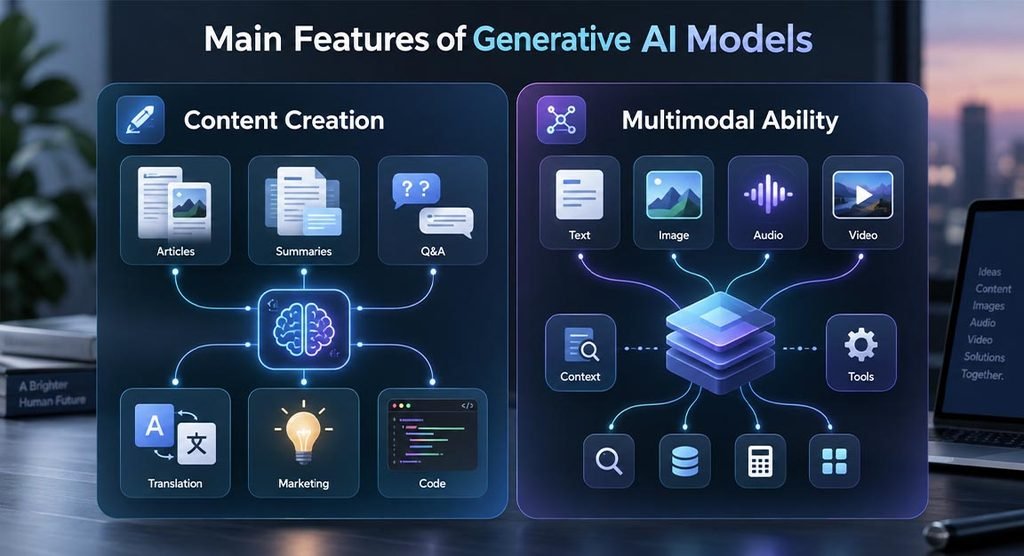
One major feature is content creation. A single system may write articles, summarise documents, answer questions, translate languages, create marketing ideas, or produce computer code. Modern systems can also understand context, meaning they can use information from earlier parts of a conversation when preparing a response.
Another important feature is multimodal ability. Some advanced models can work with more than one type of data. They may accept text, images, audio, or video and produce useful results from them. Models can also be connected to external databases, search systems, calculators, and software tools, making them more useful for real business tasks.
Types of Generative AI Models
Several technologies are used to generate content. Transformers are especially important for language. They use an attention system that helps the model understand relationships between different words in a sentence or document. Many modern large language models are based on transformer technology.
Diffusion models are widely used for images and other media. Generative Adversarial Networks (GANs) use two neural networks: a generator creates content while a discriminator checks whether it looks real. Variational Autoencoders (VAEs) learn compressed forms of data and can create new variations. Each type has different strengths and uses.
Popular Models and Examples
Several well-known AI families show how wide this field has become. OpenAI’s GPT models are designed for tasks such as writing, reasoning, coding, and conversation. Google Gemini supports multimodal tasks and can work with different forms of information. Meta’s Llama family provides models that developers can use for many language-based applications.
For visual work, Stable Diffusion is a well-known example of diffusion-based image generation. Other systems can create speech, music, and video. These examples show that Generative AI Models are not limited to chatbots. The same basic field supports creative tools, software assistants, research applications, visual design, and media production.
How These Models Are Trained
Training normally begins with a large collection of suitable data. The model studies this information many times and adjusts its parameters when its predictions are wrong. This process can require powerful computers, especially when billions of parameters and huge datasets are involved. The first large training stage is often called pre-training.
Developers may later improve the system through fine-tuning or instruction training. Fine-tuning uses additional examples for a particular task or industry. Another method is Retrieval-Augmented Generation (RAG). RAG allows the model to search an external knowledge source before answering, which can help it use current company documents or other trusted information.
Common Uses in Everyday Work
Generative systems are useful in many industries. Writers can use them to prepare drafts, titles, summaries, and ideas. Developers can use them to explain code, find possible errors, and create simple functions. Customer service teams can use AI to prepare answers to common questions, while marketing teams can explore advertisements and campaign concepts.
Education and research also benefit from these tools. AI can explain difficult subjects in simpler words, organise notes, compare information, or create practice questions. Designers can explore early visual concepts, and companies can connect models to internal documents so employees can find information more quickly.
Benefits of Generative AI Models
A major benefit of Generative AI Models is speed. Tasks that once took hours can sometimes have a useful first draft in seconds. They can also reduce repetitive work and help people test several ideas before choosing the best direction. One general model may support writing, analysis, translation, coding, and many other tasks.
Flexibility is another benefit. A user can change the prompt instead of building a completely new program for every request. However, AI works best when people review the output. It should normally support human work rather than replace careful checking, especially when the task includes important business, medical, financial, legal, or technical information.
Limitations and Risks
Generated information is not always correct. One common problem is called a hallucination. This happens when a model produces incorrect or invented information that may still sound confident. Users should therefore check important facts against trusted sources before publishing or acting on them.
Bias, privacy, copyright questions, and misuse of synthetic media are also important concerns. Models can learn unwanted patterns from training data, and realistic artificial images, videos, or voices may be used in misleading ways. Organisations should use clear data rules, security controls, human review, and responsible AI practices when using these systems.
How to Choose the Right Model
Choosing the right model begins with understanding the job. A language model may be best for writing, summarisation, customer support, or coding. An image model is more useful for illustrations and design work. A multimodal model can be useful when a task includes text, images, sound, or several types of information together.
Other factors include accuracy, speed, cost, privacy, context size, supported languages, licensing, and hardware needs. A larger model is not always the best option. Smaller specialised models may cost less and respond faster. Testing different options with real tasks can help a business or developer select a system that provides the right balance of quality and cost.
FAQs
What can generative AI create?
It can create text, images, software code, music, speech, video, summaries, designs, and other digital content, depending on the system being used.
Are AI-generated answers always correct?
No. AI can sometimes create incorrect facts or invented information. Important claims should be checked using reliable and current sources.
What is the difference between an LLM and generative AI?
An LLM mainly works with language, while generative AI is a wider field that can include text, images, audio, video, code, and other forms of content.
What is a diffusion model?
A diffusion model often starts with random noise and gradually removes that noise until it creates a useful result, such as an AI-generated image.
Why is RAG useful for AI systems?
RAG lets an AI system retrieve information from an external source before answering. This can help it use more recent, relevant, or company-specific information.