

What Growth Navigate Funding Services Offer Business Owners
Growth Navigate funding services offer business owners support with seeking capital, preparing investor pitches, and managing finances during growth. Its website advertises help with investor connections, business loans, and deal structuring. However, its terms describe a consulting service and clearly state that funding results are not guaranteed.
The value depends on the work included in the agreement. An owner may need stronger financial records, a clearer pitch, or help finding suitable funding sources. Understanding those needs before paying makes it easier to judge whether the proposed service is useful.
What Is Growth Navigate Funding?
Growth Navigate funding refers here to the advisory services promoted at growthnavigate.com. The business describes services covering capital acquisition, financial planning, business coaching, and financial technology. These areas address both raising money and managing it after funding arrives.
A separate website, growthnavigatefunding.com, uses a similar name. The available research did not confirm shared ownership, so their services, prices, and results should not be combined. Check which business appears on your proposal, invoice, and agreement before proceeding.
This distinction also prevents inaccurate expectations. A service advertised on one website may not be available from the other. This article focuses on the offering described at growthnavigate.com.
Funding Advice or Direct Loans?
Funding advice is different from receiving a loan. Growth Navigate’s reviewed pages describe consulting and capital-acquisition support. They do not establish a direct lending product with published interest rates, repayment periods, or borrowing limits.
An adviser may prepare documents, discuss funding routes, or introduce potential investors. A lender or investor still decides whether to provide capital. Owners should ask who supplies the money, who assesses the application, and whether separate agreements are required.
The funding route also affects the business differently:
| Funding route | How it works | Main trade-off |
|---|---|---|
| Business loan | Borrowed money is repaid under agreed terms. | Repayments can put pressure on cash flow. |
| Angel investment | An individual invests, usually for ownership. | The owner gives up part of the business. |
| Venture capital | An investment firm backs a business with strong growth potential. | Investors may seek influence over major decisions. |
| Self-funding | Owners use their available resources. | Personal money remains exposed to business risk. |
These are general funding options, rather than confirmed Growth Navigate financial products. The right choice depends on repayment capacity, growth plans, and how much ownership the founder wants to keep.
Pitch Decks and Investor Support
Growth Navigate explicitly advertises pitch-deck assistance, investor connections, and deal-structuring support. Its public funding page does not explain every deliverable or revision limit. Ask whether the quoted work includes research, writing, design, presentation practice, and investor follow-up.
A useful pitch deck should explain why funding would improve the business. Attractive slides cannot fix unclear pricing, weak customer demand, or unsupported forecasts. For example, a subscription company should explain whether customers stay, rather than showing only new sign-ups.
Investor introductions also need a clear definition. A direct introduction to an interested investor differs from receiving a contact list. Confirm whether potential investors match your industry, location, business stage, and requested amount.
Ask who manages replies and meetings once outreach begins. Clear responsibilities help prevent missed messages and repeated work. The agreement should describe the support provided without treating investor interest as a funding promise.
Cash Flow and Growth Planning
Growth Navigate advertises help with budgeting, forecasting, spending, cash flow, and profitability. This matters because raising money does not automatically make a business financially stronger. Poorly planned expansion can increase expenses faster than income.
Consider a manufacturer that wins a large order but must buy materials before receiving customer payment. Sales have increased, yet available cash may fall. The owner needs to calculate that payment gap before deciding how much to borrow.
A funding target should come from a spending plan. Equipment, recruitment, stock, and operating costs should connect to clear business goals. The forecast should also show what happens if sales arrive late or costs rise.
Ask which financial reports the adviser will produce and how often they will be updated. A forecast offers more value when owners can use it to make decisions. It should help explain when the business may need cash and which expenses can wait.
Growth Navigate Funding Process
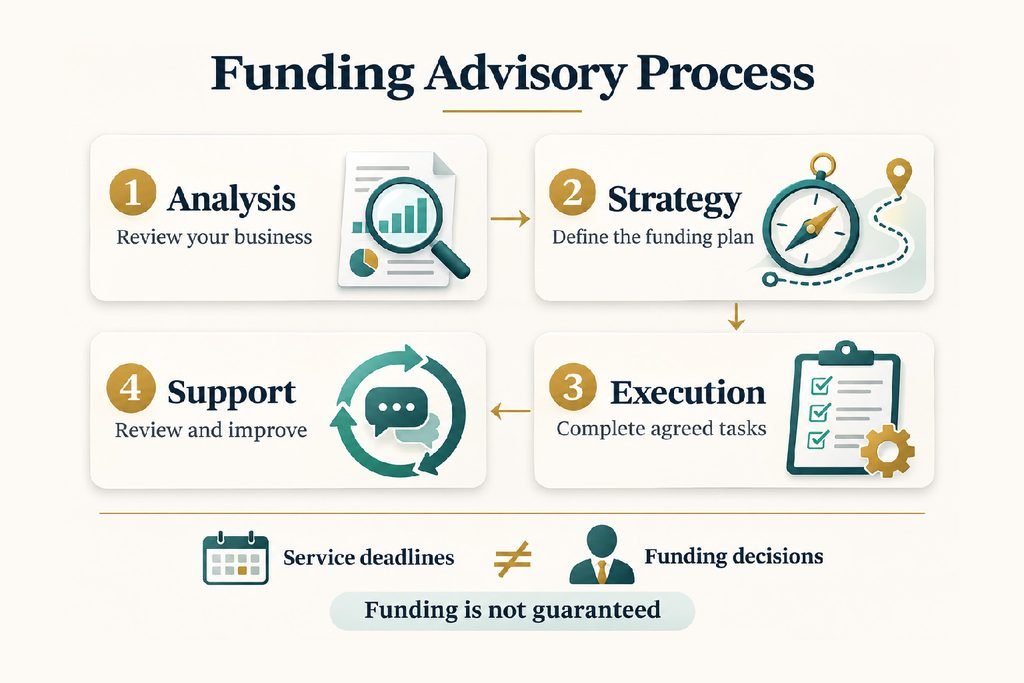
Growth Navigate publishes four broad stages: analysis and customization, strategic advisory, execution and optimization, and continuous support. These describe a general approach rather than a complete project schedule. The reviewed funding page does not provide a standard approval deadline.
Before signing, turn those stages into specific tasks. A financial review could produce a written readiness assessment, while strategy work could produce a funding plan. These are examples to request, rather than confirmed deliverables in every engagement.
Separate delivery dates from funding decisions. An adviser may control when a pitch deck is completed but cannot control when an investor decides. Your agreement should identify deadlines, responsibilities, meeting frequency, and progress updates.
Who Can Use These Services?
Growth Navigate discusses founders and businesses seeking capital, improved finances, and profitable growth. Its reviewed pages do not publish one universal minimum revenue, credit score, or operating history for consulting clients. Acceptance and suitability should therefore be confirmed directly.
A startup may need help presenting its product and market opportunity. An established company may need financial preparation before opening another location. Those businesses require different support, even when both describe their goal as “getting funding.”
The first question should be whether money is the main constraint. If customers leave because service is unreliable, extra marketing spending could increase complaints. A useful consultation should examine the business problem before recommending a fundraising project.
Funding Fees and Refund Terms
Growth Navigate’s terms place service fees in the individual client agreement. They also state that payments are non-refundable unless a written agreement says otherwise. The reviewed pages did not provide a standard public price list.
Request a quote that explains the work, payment dates, and possible extra costs. Ask whether revisions, software, legal support, or ongoing meetings cost more. If any fee depends on funding success, the agreement should define exactly what triggers payment.
Also consider what you receive if funding does not arrive. Editable presentations, usable forecasts, and organized records may support future applications if they form part of the agreed service. Judge the fee against those deliverables as well as the possible funding outcome.
Preparing for a Funding Consultation
Prepare a short business summary, the amount required, and a clear explanation of how you will spend it. Gather available financial statements, debt details, ownership information, and realistic forecasts. These documents help make the first discussion specific.
“We need money to grow” gives an adviser little to assess. “We need equipment to fulfil orders beyond our current capacity” explains the purpose more clearly. Supporting records then help test whether the investment and requested amount make sense.
Ask the adviser to identify the main gaps before recommending a large project. Financial records may need attention before investor outreach begins. Understanding the order of work can prevent spending money on materials the business is not ready to use.
What to Check Before Hiring
Growth Navigate publishes team biographies, testimonials, and claims about experience and partnerships. These are company-published statements rather than independently verified performance evidence. Request a relevant reference or case study showing the problem, work completed, and measurable result.
An overlooked issue is ownership of documents and account access. Confirm that you can keep and edit paid materials. If the adviser manages outreach, agree on how you will receive investor contact history and records when the engagement ends.
Financial privacy deserves equal attention. Its privacy policy says it may collect business financial information and share information with service providers in specified circumstances. Ask who can access records, how documents will be transferred, and when information may reach potential investors.
Choose based on a clear scope, relevant evidence, and an understandable fee. The proposal should address your actual funding problem and explain what you receive. Broad promises are less useful than work you can review and measure.
FAQs
Does Growth Navigate lend money directly?
The reviewed pages describe funding consulting rather than a defined direct loan product. Confirm who would provide any proposed loan.
Does Growth Navigate guarantee funding?
No. Its terms state that specific funding results and financial outcomes are not guaranteed.
How much do its funding services cost?
Fees depend on the individual agreement. Request a written quote covering all work and potential charges.
Can a startup without revenue use the service?
The reviewed pages do not publish a clear acceptance rule for pre-revenue businesses. Confirm suitability before paying.






One Comment