
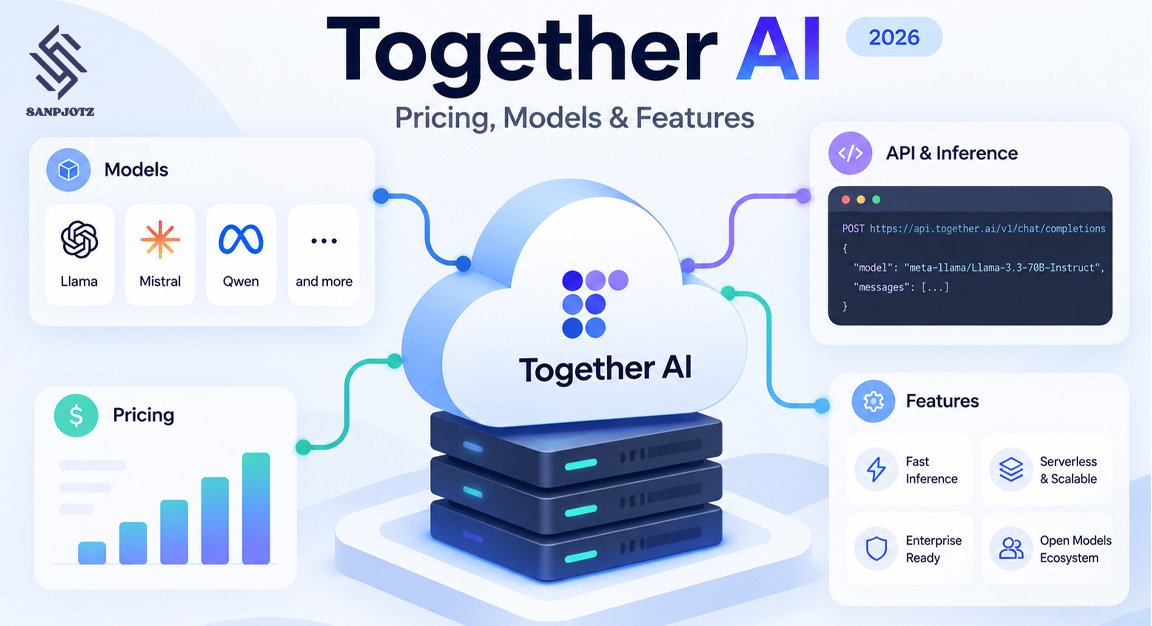
Together AI Pricing, Models, and Features: What to Know in 2026
Together AI is an AI infrastructure platform built for developers who want to run, customize, and deploy modern AI models without managing GPU servers themselves. It supports serverless inference, dedicated deployments, fine-tuning, embeddings, reranking, image generation, audio, video, and other AI workloads.
What makes Together AI interesting in 2026 is not simply the number of models it offers. The more useful part is its deployment flexibility. A small application can begin with pay-as-you-go inference and later move to reserved or dedicated infrastructure as traffic becomes more predictable.
What Is Together AI?
Together AI provides cloud infrastructure for running open and open-weight AI models through APIs. Instead of downloading a model, configuring GPUs, installing inference software, and maintaining servers, developers can send requests to a managed endpoint.
This makes the platform different from consumer tools such as ChatGPT. Together AI is mainly the infrastructure behind applications rather than the application itself.
A company could use it to build a customer-support assistant, document search tool, coding assistant, research system, AI agent, or image-generation product. The end user may never see the Together AI name because it runs behind the software.
Together AI currently supports multiple deployment approaches, including serverless inference, provisioned throughput and dedicated model inference. Each is designed for a different level of traffic, reliability and infrastructure control.
Together AI Pricing
Together AI does not use one fixed monthly price. Costs depend on the model and how it is deployed.
For text models, serverless pricing is normally shown per one million input and output tokens. Some models also have lower rates for cached input. Image, video and other media models use different pricing units.
As of October 2026, prices vary substantially across the model catalog. For example, Together AI currently lists GLM-5.3-Flash at $0.15 per million input tokens and $0.50 per million output tokens. More demanding models can cost several dollars per million tokens.
The cheapest token rate is not always the cheapest model to operate. A low-cost model that produces unnecessarily long responses or needs repeated retries can cost more per completed task than a more capable model.
For that reason, businesses should calculate cost per successful request rather than judging a model only by its advertised token rate.
Serverless Inference Costs
Serverless inference is probably the easiest starting point for most developers. Together AI manages the hardware while the customer pays based on usage.
It works particularly well when traffic is unpredictable. A new SaaS application might receive only a few hundred AI requests one day and thousands the next. Maintaining dedicated GPUs for that traffic would often mean paying for unused capacity.
Together AI describes serverless inference as suitable for rapid development, variable workloads and early production applications. It also provides access to text, image, video, code and voice models through managed infrastructure.
Batch processing can be worth considering for tasks where users are not waiting for an immediate answer. Product classification, bulk summarization, embedding generation and large evaluation jobs are good examples.
This distinction is easy to overlook. A real-time API makes sense for a chatbot where somebody expects an answer within seconds. Processing 500,000 documents overnight does not require the same infrastructure.
The smartest cost optimization is therefore often deciding when a request needs to be real-time, rather than simply searching for a cheaper model.
Available AI Models
Together AI gives developers access to models from several AI labs instead of locking applications to one model family.
Its current catalog includes models from developers and ecosystems such as Qwen, DeepSeek, Google Gemma, Meta Llama and other providers. The selection changes frequently as newer models become available.
That variety sounds simple, but model selection is where real engineering work begins.
A large reasoning model may perform well on benchmarks but be unnecessary for extracting a customer name from an invoice. A smaller model may complete that job faster and for a fraction of the cost.
Developers should test models against their own tasks rather than trusting general benchmark rankings. Important measurements include answer quality, latency, output length, tool-calling reliability and cost per successful request.
Context window size deserves similar caution. Larger context windows are useful, but sending enormous prompts with every request can increase cost and latency. Good retrieval often beats putting an entire document library into the prompt.
Fine-Tuning Options
Together AI also supports fine-tuning for teams that need more control over model behavior. Its 2026 platform supports use cases including tool-call fine-tuning, reasoning fine-tuning and vision-language model customization.
Fine-tuning is useful, but it is frequently applied to the wrong problem.
If a company wants an AI assistant to answer questions from frequently changing internal documents, retrieval-augmented generation is usually a better option. The documents can be updated immediately without retraining a model.
Fine-tuning becomes more valuable when behavior needs to change. Examples include enforcing a specific response structure, teaching a model specialized terminology, improving tool calls, producing consistent classifications, or following a narrow workflow.
Before fine-tuning, teams should create a small evaluation dataset and measure how the original model performs. Without that baseline, it is difficult to prove that training actually improved anything.
That sounds obvious, yet it prevents a common problem: spending money on customization before defining what success should look like.
Together AI API
Together AI offers APIs that developers can integrate into existing applications. Its infrastructure supports common generative AI tasks without requiring teams to build their own inference stack.
An important advantage is compatibility with familiar API patterns. This can reduce the amount of engineering work required when testing different models or moving workloads between deployment types.
But API compatibility does not mean every model behaves identically.
One model may follow JSON instructions reliably while another occasionally breaks the format. Tool calling, reasoning style, context handling and output length can also vary significantly.
Developers should therefore test model changes the same way they would test an important software update. Switching the model identifier may require only one line of code, but the application’s actual behavior can change considerably.
This is especially important for AI agents, where one unreliable tool call can affect several later steps in the workflow.
Dedicated Endpoints
Serverless infrastructure is convenient, but high-volume applications eventually need more predictable performance.
Together AI’s dedicated model inference provides reserved, isolated compute resources rather than relying entirely on shared serverless capacity. Provisioned throughput is another option for production workloads that require reserved token capacity and service guarantees.
Dedicated deployments can make sense when an application has consistent traffic, strict latency requirements or a customized model that needs its own infrastructure.
There is an important billing difference, though. Dedicated endpoints can continue generating hosting charges while they are active even if no requests are being processed. Serverless workloads, by contrast, are generally charged according to actual usage.
That makes utilization important. Dedicated infrastructure is not automatically cheaper simply because an application has grown.
Together AI has also expanded its production deployment tools in 2026. Stable endpoints can sit in front of multiple deployments, while teams can use approaches such as A/B testing, shadow traffic, canary releases and blue-green updates.
These features matter because running AI reliably is increasingly an operations problem, not just a model-selection problem.
Common Use Cases
Together AI makes the most sense when developers want access to modern AI models without taking responsibility for the entire GPU infrastructure layer.
Customer-support systems are an obvious example. A company can combine a language model with retrieval from its documentation and provide answers grounded in company information.
Search is another strong use case. Embeddings can identify semantically related documents, reranking can improve result quality, and a language model can generate a useful response from the selected material.
AI agents are increasingly important as well. They may use language models for reasoning while calling APIs, searching databases or completing structured actions.
Generative media products can also use the same broader platform for workloads involving images, audio or video.
The practical advantage is that not every part of an application has to use the same model. A cheaper model can process routine requests while a stronger reasoning model handles difficult tasks.
That routing strategy often saves more money than trying to find one model that does everything.
Limitations to Know
Together AI removes much of the infrastructure work, but it does not remove the need for AI engineering.
Teams still need to compare models, write prompts, build evaluation datasets, monitor latency and control costs. Having dozens of models available can actually create more decisions rather than fewer.
Model churn is another issue. The open-model ecosystem moves quickly, and today’s preferred model may be replaced within months. Applications built too tightly around one model’s behavior can become difficult to migrate.
Cost estimates can also be misleading if they focus only on tokens. A single user request may trigger multiple agent steps, retrieval calls, retries or model responses.
Tracking cost per completed workflow gives a much clearer view.
Caching repeated context, trimming unnecessary prompts, using smaller models for simple work and batching offline jobs are often more effective optimizations than chasing slightly cheaper token prices.
Is Together AI Worth It?
Together AI is a strong option for developers and businesses that want to build with open models without operating their own GPU infrastructure.
Its main advantage is flexibility. Teams can begin with serverless inference while traffic is uncertain, then consider provisioned or dedicated infrastructure when production requirements become clearer.
It is less relevant for someone simply looking for an AI chatbot to use personally. The platform is designed mainly for developers creating their own products and services.
The most useful way to evaluate Together AI is not to ask whether it has the cheapest advertised model. Compare the total cost of delivering a reliable AI feature, including model quality, latency, infrastructure, engineering time and failed requests.
For many development teams, avoiding the complexity of managing GPUs may be worth more than saving a small amount on every million tokens.
FAQs
Is Together AI free to use?
Together AI uses usage-based pricing for most production services. Pricing varies by model and deployment method, so developers should check the current catalog before estimating project costs.
What is Together AI mainly used for?
It is mainly used for AI inference, fine-tuning, embeddings, search, AI agents, generative media and deploying open or open-weight models inside applications.
Does Together AI support open-source models?
Yes. Open and open-weight models are central to the platform, with several model families available through managed APIs.
Is Together AI good for developers?
Yes, especially for teams that want access to multiple AI models without configuring and maintaining their own GPU servers.