
Fireworks AI: Features, Benefits and Costs
Fireworks AI is a cloud platform built for developers and companies that want to run, customize, and scale modern AI models. It focuses on fast inference, open models, multimodal tools, fine-tuning, and flexible deployment. Instead of building costly GPU systems from the beginning, teams can connect through an API and start using advanced models for chat, coding, search, document work, image tasks, audio, and AI agents.
What Is Fireworks AI and How Does It Work?
Fireworks AI works as an infrastructure layer between an application and an AI model. A developer chooses a supported model, sends requests through an API, and receives generated results. The platform manages much of the difficult work, including GPU resources, model loading, traffic handling, scaling, memory use, and performance. This makes it easier to build AI products without managing every technical part alone.
The service is mainly designed for developers, AI startups, machine-learning teams, and larger businesses. It also provides an OpenAI-compatible API, which can make migration easier for teams already using OpenAI-style requests. Developers can work with REST APIs, Python tools, and command-line utilities while keeping control over model choice and deployment settings.
Main Fireworks AI Features for Developers
One major strength of Fireworks AI is its wide set of developer tools. The platform supports text generation, structured outputs, tool calling, reasoning models, embeddings, reranking, batch inference, model training, and fine-tuning. These tools can be combined to create chatbots, coding assistants, customer-support systems, search engines, document tools, data extraction services, and more advanced AI agents.
Structured outputs are especially useful when software needs a clear format such as JSON instead of normal text. Tool calling lets a model connect with outside services, databases, or business APIs. Batch inference can process large numbers of requests without requiring an instant result, which may lower costs for jobs such as classification, document analysis, and training-data generation.
Fireworks AI Models and Multimodal Support
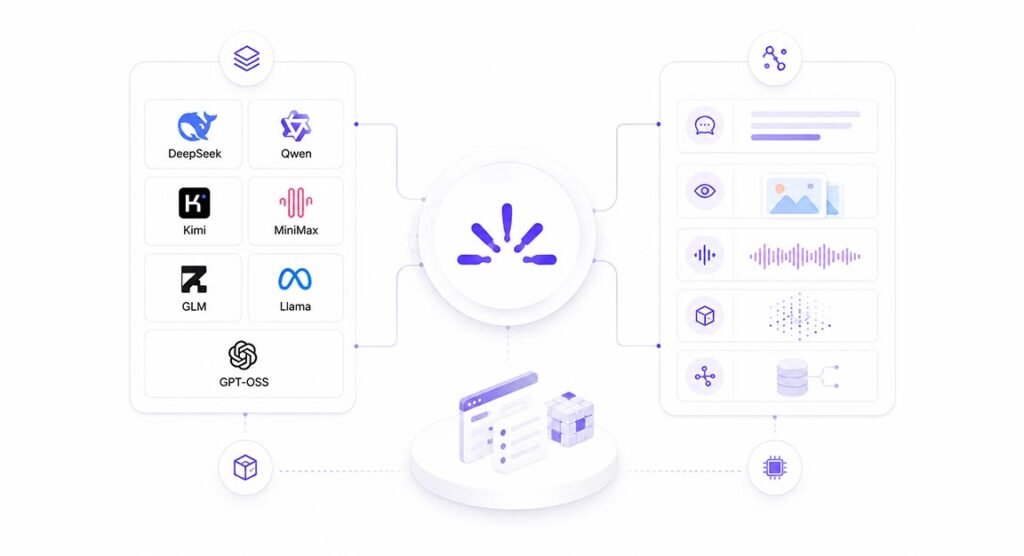
The platform gives developers access to many open and open-weight AI models. Available families have included DeepSeek, Qwen, Kimi, MiniMax, GLM, Llama, and GPT-OSS. Model availability changes over time as new releases appear, so users should check the current model catalog before choosing a system for production.
Support is not limited to normal text models. Developers can work with vision, image, audio, embeddings, and other multimodal workloads. This makes it possible to build software that can read documents, understand pictures, process speech, create images, search large knowledge collections, or combine several types of AI inside one application.
Serverless vs Dedicated Inference Options
Fireworks AI offers serverless inference for users who want a simple way to start. With serverless service, a developer does not need to reserve a private GPU. The platform runs supported models on shared infrastructure, while the customer normally pays according to token usage. This option works well for testing, small products, changing traffic, and projects that do not need dedicated hardware.
For larger workloads, Fireworks also provides on-demand dedicated deployments. These use GPU resources assigned to the customer and can offer more predictable performance, higher capacity, private model hosting, and greater scaling control. Dedicated deployments are usually billed by GPU usage rather than only by tokens. Automatic scaling can increase resources during busy periods and reduce them when traffic falls.
Fireworks AI Fine-Tuning and Custom Model Tools
Developers can customize models through fine-tuning, which trains an existing model on examples related to a specific task. A company may use fine-tuning for customer service, product descriptions, legal text, internal workflows, classification, or a special writing style. This approach can produce more focused behavior without training an entirely new large language model from zero.
The platform also supports LoRA, or Low-Rank Adaptation. LoRA creates a smaller adapter that changes model behavior while keeping the main model mostly unchanged. This can reduce storage and training needs. More advanced teams can also work with techniques such as supervised fine-tuning, preference optimization, and reinforcement-based training for specialized AI systems.
Fireworks AI Pricing and Token Costs
Pricing depends on the model and deployment type. Serverless text models are usually charged by input and output tokens, commonly shown as a price per one million tokens. Smaller models can cost much less than large reasoning models. Cached input tokens may also receive lower pricing because the system can reuse repeated prompt information instead of processing it fully each time.
Dedicated deployments use another pricing structure based mainly on GPU time. Hardware such as H100, H200, B200, B300, and GB300 GPUs may have different hourly prices. Fireworks announced changes to some GPU prices from September 1, 2026, so businesses should always check current pricing before creating a production budget. Self-service accounts also moved to a prepaid billing model on July 1, 2026.
Main Benefits of Using Fireworks AI
The biggest benefit of Fireworks AI is flexibility. Developers can choose between several models instead of depending on one model provider. They can start with serverless inference, test different models, and later move to dedicated infrastructure when traffic or performance needs increase. This gives both small teams and larger companies more options as their products grow.
Performance is another important benefit. The platform is designed around optimized inference, GPU efficiency, caching, batching, and scaling. It also supports features such as reasoning controls, tool calling, and structured responses. These tools can help teams create AI applications that are faster, more reliable, and easier to connect with real business systems.
IT Security, Privacy and Compliance
Security matters when AI systems handle private business information. Fireworks states that normal prompts and model responses are generally not stored or logged, although service metadata such as token counts may be kept. Some special features can have different rules, so organizations should review the exact product settings before using sensitive or regulated information.
The company also lists compliance and security programs including SOC 2 Type II, ISO 27001, ISO 27701, ISO 42001, HIPAA support, GDPR-related controls, and CCPA-related controls. Enterprise users may also receive features such as role-based access controls and single sign-on. However, every business remains responsible for checking whether its own setup meets legal requirements.
Fireworks AI Limitations and Things to Consider
The platform may not suit every user. It is mainly a developer-focused service, so people looking for a simple consumer chatbot may find it more technical than tools designed for everyday use. Serverless models can also have rate limits, and not every model supports every feature, including fine-tuning, reasoning controls, batch processing, multimodal input, or the same context length.
Costs can also grow if a team chooses powerful models or dedicated GPUs without careful planning. Fine-tuned LoRA models may require dedicated deployment, which can be more expensive than basic serverless use. Developers should compare model quality, latency, token prices, GPU costs, traffic levels, and feature support before selecting a production setup.
Who Should Use It in 2026?
Fireworks AI is a strong option for developers and companies that need more control over AI infrastructure. It can fit startups building new AI products, software companies adding assistants or search, research teams testing open models, and enterprises that need dedicated hardware, custom models, or stronger deployment controls.
It is especially useful when a project needs fast inference, open-model choice, fine-tuning, AI agents, multimodal processing, batch jobs, or dedicated GPU deployment. Smaller projects can begin with serverless pricing, while larger applications can move toward private infrastructure. The best choice depends on expected traffic, model quality, privacy needs, latency targets, and total cost.
FAQs
Is Fireworks AI free to use?
It may offer limited credits or testing options depending on the current account program, but normal production use is paid. Costs depend on the chosen model, token usage, and deployment type.
What models does Fireworks support?
The platform supports many open and open-weight model families, including DeepSeek, Qwen, Kimi, MiniMax, GLM, Llama, and GPT-OSS, although availability can change.
Does Fireworks support fine-tuning?
Yes. Developers can fine-tune supported models and use methods such as LoRA, supervised fine-tuning, and advanced training workflows for specialized applications.
Is Fireworks suitable for large businesses?
Yes. It provides dedicated deployments, enterprise security features, regional infrastructure, access controls, and custom model options for larger production workloads.
How is Fireworks pricing calculated?
Serverless services are generally priced by input and output tokens, while dedicated deployments are mainly priced by GPU usage time. Exact rates depend on the model and hardware.