

Maven AI: Tools, Features and Use Cases
Maven AI is an analytics assistant built into Usermaven. It helps businesses understand website traffic, marketing campaigns, customer journeys, conversions, and product activity through simple questions. Instead of opening many reports and changing filters, users can ask questions in normal English. The system studies available analytics data and gives useful answers. It is mainly designed for marketers, SaaS companies, product teams, agencies, founders, and ecommerce businesses.
What Is Maven AI and How Does It Work?
Maven AI works with information collected inside Usermaven. The platform can record page views, website sessions, traffic sources, user actions, conversions, product events, and other business data. Users can then ask questions about this information without needing advanced SQL or data-analysis skills.
For example, a marketing manager can ask which channel produced the most signups last week. The assistant can examine the available information and show the result. Users can continue the conversation by asking about paid campaigns, conversion rates, revenue, or another period. This conversational system reduces the need to build a new report for every question.
Main Tools Available for Analytics
One of the main tools is conversational analytics. It allows people to ask questions in plain English about traffic, engagement, attribution, campaigns, and conversions. Users may ask about their best-performing traffic source, changes in visitor numbers, or the campaigns producing the highest return.
Another useful tool is the AI dashboard builder. A user can describe a dashboard they need, and the system can create reports and relevant dashboard tiles. It can include information such as signups, customer acquisition cost, attribution, retention, and conversion paths. Saved results can also become reusable reports.
Key Features That Make Data Easier to Understand
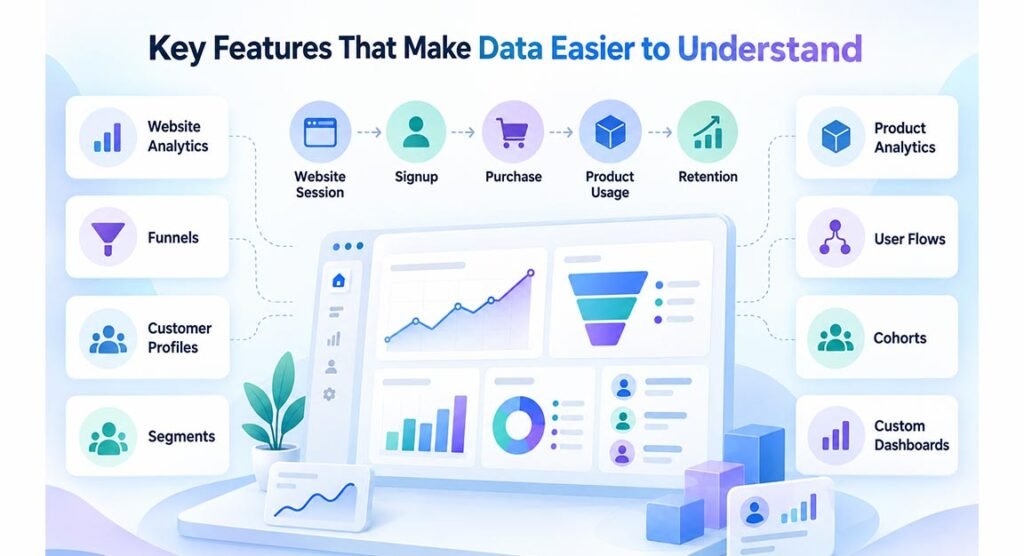
Maven AI does more than display numbers. It is designed to explain analytics information in a form that is easier for business users to understand. It can identify important changes, compare time periods, highlight strong marketing channels, and help teams investigate changes in conversions.
Usermaven also supports website analytics, product analytics, funnels, user flows, customer profiles, segments, cohorts, and custom dashboards. These features provide the data behind deeper analysis. Businesses can therefore study the full journey from a visitor’s first website session to signup, purchase, product usage, and retention.
Website Analytics and Traffic Insights
Website owners need to know where visitors come from and what they do after arriving. Usermaven can measure visitors, page views, sessions, traffic sources, landing pages, and conversions. This makes it easier to find pages and channels that are producing useful results.
Businesses can also compare performance between different periods. For example, they may check whether organic search traffic grew during the last month or whether a campaign caused a sudden traffic increase. Usermaven also supports tools such as Google Search Console, which can give businesses more information about their search marketing performance.
Marketing Attribution and Conversion Paths
A customer does not always purchase after one website visit. Someone may first discover a business through Google Search, return through a social ad, open an email, and later make a purchase. Marketing attribution helps businesses understand which channels played a role in that journey.
Maven AI can help teams study attribution and conversion paths so they can understand which sources contribute to signups, purchases, and revenue. Usermaven supports paid ads, channel and content attribution, CRM deal attribution, and conversion-path analysis on its Scale plan. These tools can give marketers a better view than looking only at the final click before a sale.
Funnels, Retention and Customer Journeys
Funnels help companies see where users leave before finishing an important action. An ecommerce funnel might be Product Page → Cart → Checkout → Purchase. A SaaS company could track Landing Page → Signup → Trial → Paid Plan. When many users leave at one step, the business can investigate the problem.
Retention analysis looks at whether customers continue to use a product over time. Customer journey reports give an even wider view by showing different interactions before and after conversion. Together, these tools help businesses understand acquisition, engagement, conversion, and long-term customer activity.
Product Analytics for SaaS and Digital Businesses
Product teams can track actions that happen after a person becomes a user. These actions may include completing onboarding, creating a project, using an important feature, inviting another user, upgrading a subscription, or becoming inactive.
This information can answer important questions about product growth. Teams may discover which features are used by loyal customers or where new users stop during onboarding. Combining product analytics with marketing data also helps businesses understand the complete customer experience instead of treating acquisition and product usage as separate areas.
Integrations and MCP Support
Usermaven offers integrations for popular business and marketing systems. Its current Scale features include connections involving Google Ads, Meta Ads, LinkedIn Ads, HubSpot, Salesforce, Slack, Stripe, WordPress, Google Search Console, and other supported services. Availability can depend on the plan or integration status.
Another important technology is MCP, or Model Context Protocol. Usermaven provides MCP access for AI agents on its Scale plan. This can allow compatible AI assistants and agents to work with analytics information. It can be useful for companies creating automated workflows that connect analytics with other AI-based business tasks.
Common Business Use Cases
Maven AI can serve different teams because analytics questions are not limited to one department. Marketing teams can study campaign results, attribution, conversions, and traffic. Product teams can examine onboarding, feature usage, funnels, and retention. SaaS companies can connect marketing acquisition with user behavior after signup.
Ecommerce businesses can study traffic, purchases, revenue, and customer journeys. Agencies can prepare dashboards and reports for clients, while founders can quickly check important performance numbers. This is especially helpful when a person needs an answer but does not want to manually search through many analytics reports.
Pricing, Benefits and Important Limitations
According to Usermaven’s current documentation, the Growth plan starts at $84 per month for 250,000 monthly events, while the Scale plan starts at $199 per month for 250,000 events. Access to the AI assistant is listed under Scale. Annual billing can reduce the cost, while Enterprise pricing is customized for larger organizations.
The biggest benefit of Maven AI is easier access to complex analytics. However, it cannot fix poor tracking automatically. Missing events, incorrect campaign tags, incomplete revenue data, or weak user identification can affect results. Businesses should therefore set up their analytics correctly and review important AI findings before using them for major decisions.
Is Maven AI Worth Using in 2026?
The platform can be valuable for companies that already collect website, marketing, and product information but want to understand it faster. Conversational questions, dashboards, attribution, funnels, retention, customer journeys, and automated reporting can reduce the amount of manual analysis required.
It is especially suitable for marketing teams, SaaS businesses, agencies, product managers, ecommerce companies, and founders. Smaller sites should compare the price with their analytics needs, while larger teams may gain more value from advanced attribution, reporting, integrations, and AI-assisted analysis.
FAQs
What is Maven AI used for?
It is used to analyze website traffic, marketing attribution, conversions, customer journeys, product activity, and business performance through natural-language questions.
Do I need coding skills to use it?
No. The analytics assistant is designed so users can ask questions in normal English. SQL knowledge is not required for its main conversational features.
Can it create analytics dashboards?
Yes. Its AI dashboard builder can create reports and dashboard tiles based on a user’s request, including attribution and retention information.
Is it useful for marketing teams?
Yes. Marketing teams can use it to understand campaign performance, traffic sources, conversion paths, attribution, and revenue.
Does Usermaven offer AI features on every plan?
The current Usermaven documentation lists access to its main AI assistant and advanced AI features under the Scale plan, which starts at $199 per month for 250,000 monthly events.