

Duolingo vs Rosetta Stone: Pricing, Lessons and Features
Choosing a language app can be difficult because Duolingo and Rosetta Stone are both well known, but they teach in very different ways. This Duolingo vs Rosetta Stone guide explains pricing, lesson style, speaking, grammar, language choice, AI tools, and the type of learner each service may suit. Duolingo uses short game-like lessons and has a strong free option, while Rosetta Stone focuses more on immersion, pictures, native-speaker audio, and pronunciation.
Duolingo Pricing vs Rosetta Stone Pricing
Duolingo lets people use its main language courses for free. Super Duolingo removes ads and adds benefits such as unlimited hearts and extra practice. Its Family Plan can cover up to six accounts. Duolingo Max sits above Super and adds AI tools. Prices vary by country, store, plan, and promotion, so the amount shown in the app may differ from one user to another.
Rosetta Stone is mainly a paid service. Its current U.S. site lists $19.99 per month or $159 per year, before special discounts. Rosetta Stone Sapphire also offers a 7-day trial, and direct plans may include a 14-day money-back guarantee. A Sapphire subscription gives access to all 25 supported languages.
Lesson Structure and Daily Learning Experience
A Duolingo vs Rosetta Stone comparison becomes very clear when you look at the lessons. Duolingo uses short exercises such as matching words, translating sentences, listening to audio, choosing answers, and speaking into the microphone. XP, streaks, leagues, and daily goals make practice feel like a game and encourage users to return every day.
Rosetta Stone lessons feel more controlled and immersive. Learners connect pictures, sounds, words, and sentences without depending heavily on English translation. The course slowly moves from simple language to longer phrases and useful situations. This may feel harder at first, but it trains learners to understand meaning through context.
Teaching Methods: Gamification vs Immersion
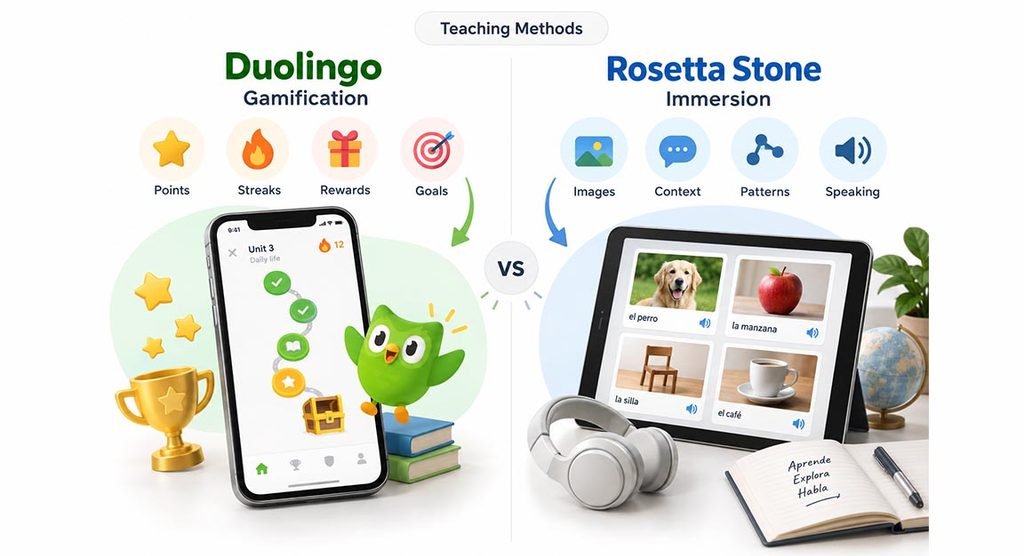
Duolingo is built around gamification. Points, streaks, reminders, rewards, and short goals make learning easier to fit into a busy day. This style can work well for people who need motivation and enjoy quick progress. Duolingo also combines this game-like design with learning science and structured course paths.
Rosetta Stone uses Dynamic Immersion. New words are connected with images, actions, and situations instead of always being translated. Grammar is often learned by seeing the same pattern in several examples. This can suit learners who want to think directly in the new language.
Speaking and Pronunciation Practice
Duolingo includes microphone exercises and speaking-only practice. Duolingo Max adds Video Call and Roleplay, where learners can have AI-supported conversations with Duolingo characters. These tools give learners a low-pressure place to speak and build confidence. The free Practice tab also includes focused speaking activities.
Rosetta Stone places pronunciation at the center of its learning system. TruAccent checks the learner’s speech against data from native-speaker pronunciation and gives quick feedback. Sapphire also includes Chat Missions, which offer conversations based on travel, work, and daily life, with grammar, spelling, and vocabulary feedback.
Grammar, Vocabulary, Reading and Listening Tools
Duolingo teaches grammar through sentence building, translation, examples, and repeated practice. Its Practice area includes activities for speaking, listening, vocabulary, and mistakes. Some courses also include Stories, Radio, and other interactive activities. Several major courses now contain material through B2 on the CEFR scale.
Rosetta Stone normally teaches grammar through patterns instead of long explanations. Its Sapphire platform also offers more than 500 themed flashcard sets in 25 languages, covering food, travel, sports, entertainment, and social situations. Native-speaker audio appears throughout the course, helping learners connect written language with pronunciation.
Language Options, Course Levels and Offline Access
Duolingo offers a wider language selection, with 40+ languages and hundreds of individual courses across different starting languages. Popular choices include Spanish, French, German, Italian, Japanese, Korean, Chinese, Arabic, and Portuguese. However, major courses usually contain more advanced material than smaller courses.
Rosetta Stone Sapphire includes 25 languages, including Spanish, French, German, Italian, Japanese, Korean, Arabic, Mandarin Chinese, Hindi, Russian, and Portuguese. Supported mobile lessons can also be downloaded for offline study. This can be useful during travel or when a stable internet connection is not available.
Duolingo Max vs Rosetta Stone Sapphire Features
Duolingo Max includes the benefits of Super plus AI-supported tools such as Video Call, Roleplay, and personalized answer help. Video Call lets learners have spoken conversations with characters, while Roleplay creates real-life practice situations. Feature availability can depend on the language, device, and region.
Rosetta Stone Sapphire adds modern tools to the classic immersion system. Chat Missions provide guided conversations, while users also receive access to more than 500 flashcard sets and Sapphire Studio tools. Chat Missions currently support 25 languages and give corrections and learning tips during conversations.
Which App Is Better for Beginners, Travel and Serious Study?
When choosing between Duolingo vs Rosetta Stone, beginners may find Duolingo easier because it offers free access, translations, short lessons, and a game-like design. Rosetta Stone may appeal more to learners who want less translation, stronger pronunciation work, and an immersive learning style from the beginning.
For travel, both can teach useful words and everyday situations. For serious study, either service works better when combined with real conversations, books, videos, writing, and native audio. Regular contact with real language is still important because no single app can fully develop every communication skill.
Duolingo vs Rosetta Stone: Which One Fits Your Learning Style?
Duolingo is attractive if you want a free starting point, a larger language list, quick lessons, and strong motivation tools. Rosetta Stone is attractive if you prefer a structured paid course, immersion, repeated pronunciation practice, and fewer translation-based exercises. Your budget and the way you enjoy studying matter more than the brand name.
The main Duolingo vs Rosetta Stone difference is the learning experience. Duolingo feels more like a language game built for daily habits, while Rosetta Stone feels like an immersion course built around understanding and pronunciation. Trying the free content or trial first can show which system feels natural enough for you to keep using.
FAQs
Is Duolingo free to use?
Yes. Duolingo provides free access to its main language courses. Paid plans remove some limits and add extra practice or AI-supported features.
Does Rosetta Stone offer a free plan?
Rosetta Stone is mainly a paid service. Its Sapphire service currently offers a limited trial so new users can test the learning system before paying.
Which one is better for pronunciation?
Rosetta Stone has a strong pronunciation focus through TruAccent. Duolingo also offers speaking practice, with more conversation tools available through Max.
Can either app make me fluent?
Both can build useful language skills, but fluency normally also needs real conversations, reading, writing, listening, and regular practice outside the app.
Which service has more languages?
Duolingo offers more languages overall, with 40+ languages, while Rosetta Stone Sapphire currently gives subscribers access to 25 languages.





2 Comments