

Artificial Analysis: Intelligence, Speed and Cost Explained
Artificial Analysis is an independent AI benchmarking company that helps people compare AI models, providers, cloud systems, and hardware. Its data is useful because one model can be strong in reasoning but slow, while another may be cheaper and faster for daily work. The platform looks at intelligence, response speed, latency, token use, and price, helping users judge models with more than one number.
What the Platform Measures
The company tests AI agents, language models, image models, video models, speech systems, music models, cloud services, and AI chips. Its current public information says it has benchmarked more than 500 models, 100 inference providers, and 1,000 endpoints. This wide coverage helps developers, businesses, researchers, and buyers compare the AI market.
The service does not only ask which model gives the best answers. It also studies how the model is delivered to users. For API services, the same model may run at different speeds or prices on different providers. So both model choice and provider choice affect the user experience.
How the Artificial Analysis Intelligence Index Works
The main language-model score is the Intelligence Index. As of September 2026, the current public version is v4.3. It combines 10 evaluations and groups them into four areas: Agents 30%, Coding 20%, General 30%, and Scientific Reasoning 20%. The aim is to test useful problem-solving skills across several benchmarks.
The index includes AA-Briefcase, GDPval-AA v2, AutomationBench-AA, Terminal-Bench v4.0, SciCode, Humanity’s Last Exam, GDP.pdf, CritPt, AA-Omniscience, and AA-LCR v1.1. Some tasks or answers are private. In v4.3, these evaluations make up 45% of the total weight, helping reduce the risk of direct training on public test material.
What Intelligence Scores Really Mean
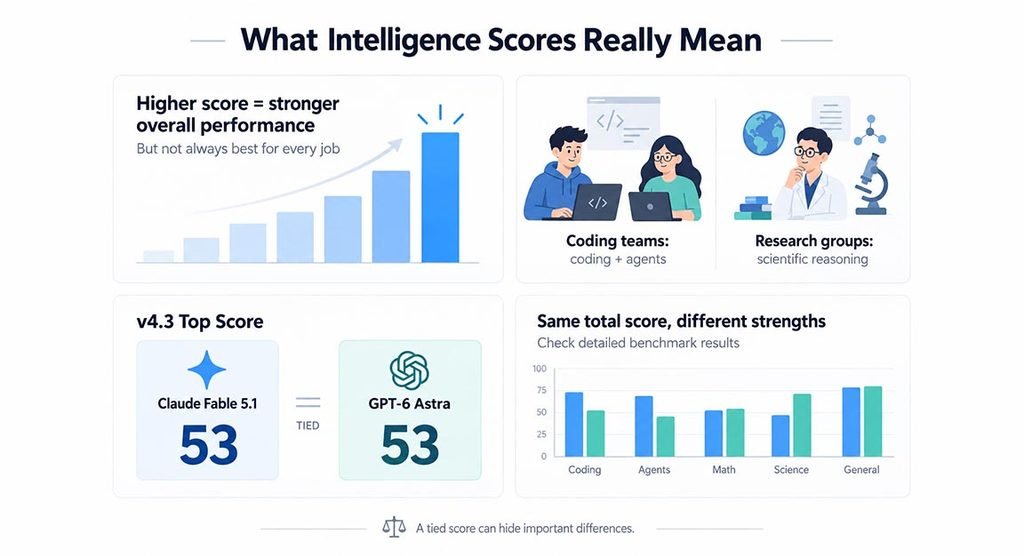
A higher score suggests that a model performs better across the weighted set of tasks, but it does not mean the model is best for every job. A coding team may care more about coding and agent tests, while a research group may care more about scientific reasoning. Users should therefore open detailed benchmark results instead of looking only at the final score.
Current results also show why this matters. In the v4.3 release, Claude Fable 5.1 and GPT-6 Astra were both reported at the top with a score of 53 under the listed high-effort settings. However, the two models showed different strengths across individual evaluations. A tied score can still hide important differences.
How Speed and Latency Are Measured
Artificial Analysis measures output speed in tokens per second after generation begins. A higher number means the model produces text faster once it starts answering. It also tracks Time to First Token, which measures how long a user waits before the first token arrives. For reasoning models, that first token may be part of reasoning rather than the final answer.
Another useful metric is Time to First Answer Token. This shows the delay before the user receives the first actual answer token after any reasoning period. The platform also reports End-to-End Response Time, covering input processing, reasoning, and answer generation. So a model with high token speed can still feel slow if it spends a long time reasoning first.
How AI Model Cost Is Calculated
Pricing is more complex than one dollar figure. Providers often charge different rates for input tokens, output tokens, and cached tokens. Artificial Analysis also gives a blended price, using a 7:2:1 ratio for cache-hit, input, and output tokens. This gives a simpler comparison, but real bills still differ by workload.
The platform also reports Cost per Task for its Intelligence Index workload. This uses token prices and the amount of input, cached, reasoning, and output tokens used by a model. Two models can have the same token price but different total costs. A model that reasons longer or produces more tokens may cost more to complete the same benchmark task.
Intelligence, Speed, and Cost Should Be Read Together
The best model is not always the model with the highest intelligence score. A customer-support chatbot may need fast first responses and low cost more than maximum reasoning power. A coding agent or scientific assistant may need stronger reasoning even when each task costs more. This is why intelligence, latency, speed, and cost should be treated as separate parts of one decision.
A useful way to choose is to start with the work you need to complete. First, find models with enough intelligence for that task. Next, remove models that are too slow for your users. Then compare cost per task or token prices among the remaining options. This is often more practical than simply choosing the top-ranked model.
How to Compare Models and Providers
Artificial Analysis provides comparison pages showing Intelligence Index scores, token prices, cost per task, output speed, time to first token, response time, context window, release date, reasoning support, and supported modalities. These details show important trade-offs side by side.
Provider comparisons are also valuable. The same model can have large differences in speed, latency, and blended price depending on the API provider. The platform says its performance tests aim to represent the normal experience of customers using standard public endpoints rather than special optimized systems. Provider-level testing is useful once a developer knows which model they want.
Limits of AI Benchmark Rankings
Benchmarks are useful, but they are not a perfect prediction of real work. A model can score well on test tasks and still fail with a company’s private data, special instructions, local language needs, or long workflows. Results can also change when new models, providers, or benchmark versions arrive. Rankings should therefore be treated as strong evidence, not a final answer.
The best approach is to use benchmark data to create a shortlist and then run your own tests with real prompts. Check answer quality, failure rate, speed, latency, and monthly cost under your normal workload. This gives a more complete view than public rankings alone and can help you select a model that fits your actual needs.
FAQs
What is the Intelligence Index?
It is a combined benchmark score that measures model ability across agents, coding, general tasks, and scientific reasoning.
Does the fastest AI model have the highest intelligence?
No. A model can generate tokens very quickly but score lower on difficult reasoning, coding, or agent tasks.
What does cost per task mean?
It estimates the average dollar cost of completing one benchmark task based on token prices and actual token use.
Why is time to first answer token important?
It shows how long users wait before the model starts giving the visible answer, especially when a reasoning model thinks first.
Should I choose a model only from benchmark rankings?
No. Use rankings to narrow your choices, then test the strongest options using your own prompts, budget, workload, and quality needs.






One Comment